Baroque
The Calling of Saint Matthew
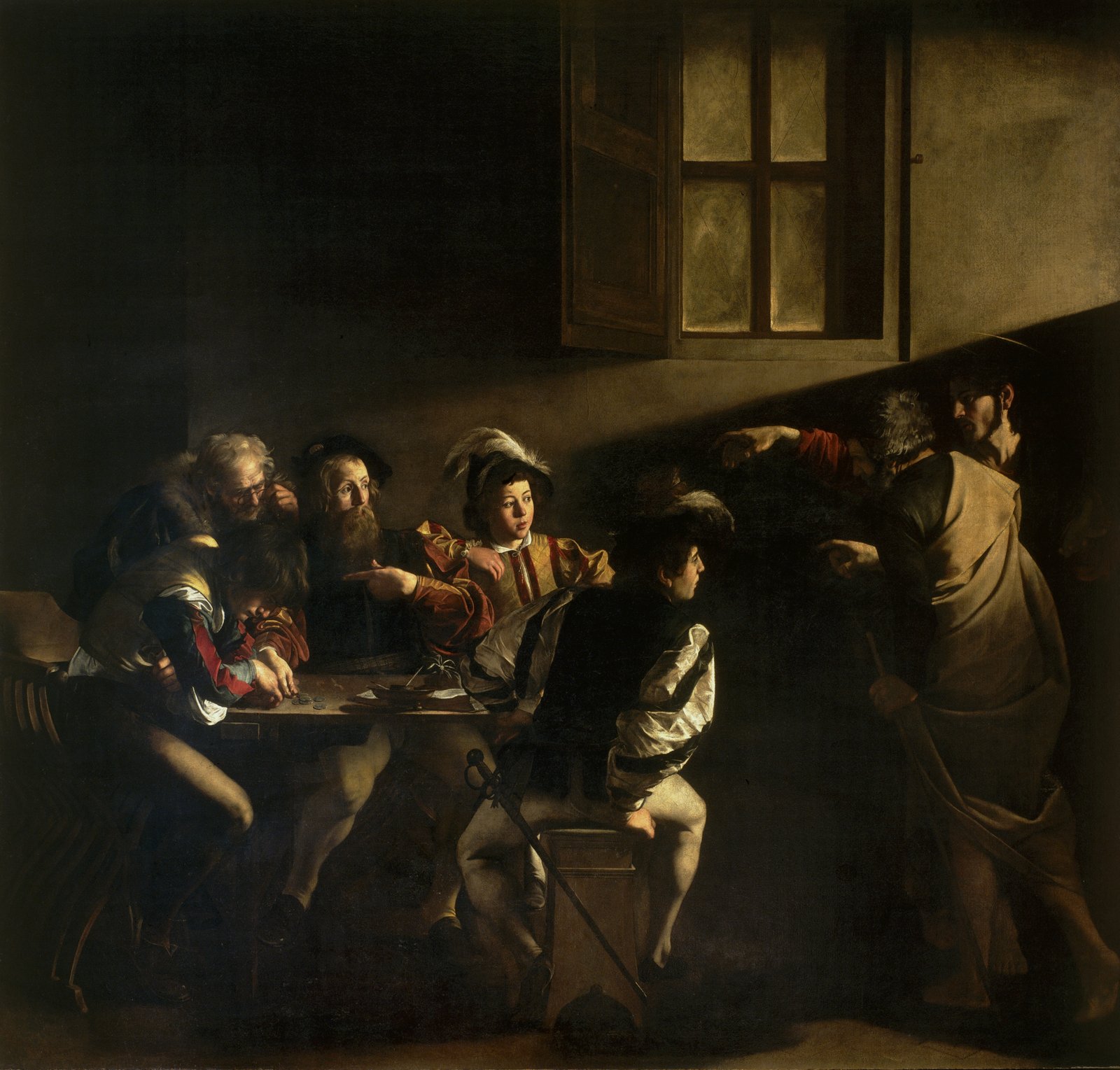
A beam of light and a pointed finger turn an ordinary tavern into a moment of destiny.
A divine interruption
The scene looks like a counting table in a dim tavern. Men are focused on money, heads down, when a sudden light cuts across the room.
Christ enters almost quietly, yet the gesture of his hand creates a shock wave. The painting feels like a sudden question asked in the middle of ordinary life.
Light as revelation
Caravaggio uses a diagonal beam of light to guide the eye to Matthew's face. The light does not just illuminate; it reveals a choice forming in real time.
Darkness surrounds the group, making the light feel physical, almost like a hand reaching into the room.
The Counter-Reformation response
The church wanted images that felt immediate and human. Caravaggio answered by painting saints who look like the people in the street.
This approach makes the story feel available to anyone: the sacred is not distant, it is right here.
Legacy of realism
Caravaggio's dramatic realism changed European painting. The Calling of Saint Matthew became a blueprint for storytelling through contrast and gesture.
The picture still feels modern because it treats belief as a moment of choice rather than a fixed pose.
Looking closer
Matthew's gesture is ambiguous. Is he pointing to himself or to someone else? That uncertainty makes the moment feel alive.
The light source seems to come from outside the painting, as if the viewer is standing in the doorway.
Caravaggio makes revelation feel like a door opening in a dark room.