Renaissance
Vitruvian Man
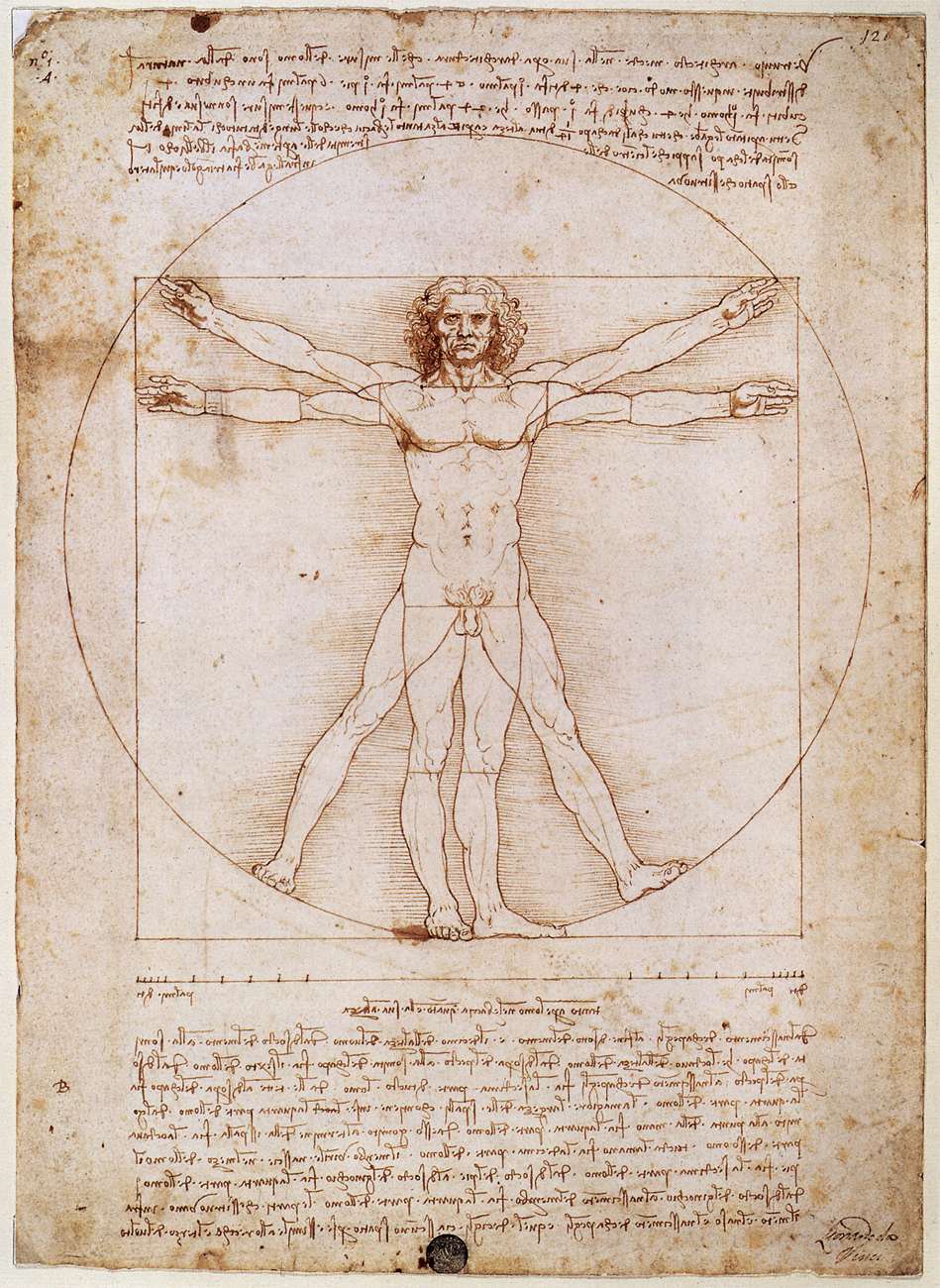
Open Leonardo's notebook and you find a man inside a circle and a square. It feels like an experiment captured mid-thought, where art and measurement briefly become the same thing.
Geometry as vision
The figure stands with arms and legs extended to touch a circle and a square. These shapes were symbols of cosmic order and earthly stability.
Leonardo uses the body to connect the two, suggesting that human proportions can bridge the natural and the mathematical.
Humanism on a page
Renaissance humanism placed the individual at the center of knowledge. This drawing makes that belief visual, turning the human body into a measure of the universe.
It is both scientific and poetic, a diagram that still feels personal.
Legacy
Vitruvian Man has become an emblem of balance, health, and human potential. It appears everywhere from textbooks to logos.
Its power comes from simplicity: a single figure that makes an enormous claim.
Looking closer
Leonardo shows the body in two positions at once, giving the sense of motion inside a diagram. It feels like a sketch caught in mid-thought.
The notes around the figure are part of the artwork. They remind you that this image is also research: a drawing that thinks on paper.
A sketch that quietly claims the body can explain the world.